
This is Chapter 1 of my book “Star Trek: The Original Series”, an episode companion examining every episode of The Original Series, The Animated Series and the movies. “The Cage” is the pilot episode, with a different cast than the rest of the series. It was not shown along with the other episodes, until finally broadcast in 1988. If you enjoy reading “The Cage”, consider buying the book for your collection.
……….
The Cage first aired on October 15, 1988; Episode 00, Series 1 of Star Trek: The Original Series, written by Gene Roddenberry and directed by Robert Butler, starring Jeffrey Hunter as Captain Christopher Pike, Leonard Nimoy as Mr. Spock, Majel Barrett as Number One, Susan Oliver as Vina, and John Hoyt as Dr. Phillip Boyce.
The Enterprise answers a distress call from Talos IV and Pike is captured by telepathic Talosians, who use powerful illusions to test and manipulate him. They want Pike to mate with Vina, a lone survivor, to rebuild a human colony under their control. Pike resists their schemes, and when the crew attempts a rescue the Talosians learn that humans reject captivity; they release the Enterprise, while Vina chooses to remain with the Talosians, living with the illusion of wholeness.
Plot Outline
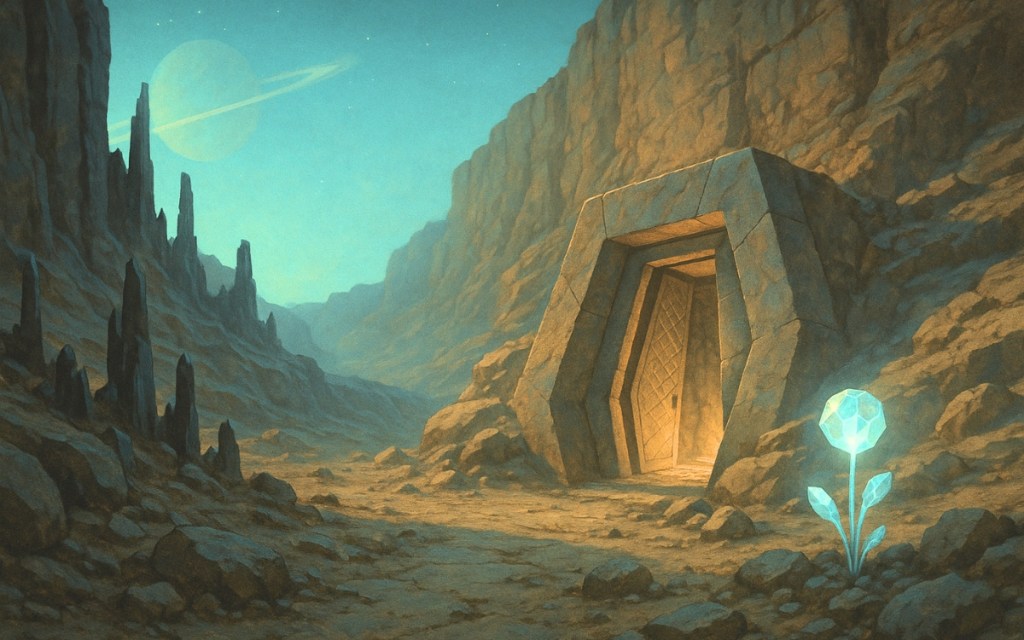
The USS Enterprise answers a distress call from Talos IV, reporting survivors of a long-ago crash. Captain Pike, wearied by recent losses and privately mulling whether to continue in command, leads a landing party to a rocky, wind-carved valley where a cluster of rough shelters and cheerful voices promise relief. The group is welcomed by a kindly doctor who explains how they have endured for years. Among them is Vina, a striking young woman who seems particularly drawn to Pike.
The captain’s suspicion flickers, but the scene is disarmingly ordinary: until the “survivors” vanish like smoke. A hidden doorway opens in the hillside, and grey-skinned, large-craniumed Talosians stun Pike and pull him below ground. He awakens behind a transparent barrier, a specimen in an underground menagerie. The Talosians communicate by thought, projecting seamless illusions that turn bare rock into fully inhabited worlds.
They present Vina to Pike again, now inside a sunlit picnic at his Mojave home, a pastoral fantasy designed to soothe him. They reveal their purpose: their civilisation once destroyed itself by leaning wholly on mental powers. Now, unable or unwilling to build, they wish to breed a hardy slave race (humans) guided by illusions that make captivity feel like paradise. Pike is to be the male breeding stock; Vina is the mate.
Pike resists, testing the cage’s limits. Rage, pain, and raw stubbornness create psychic “noise” that clouds the Talosians’ reading of his mind. The Talosians respond by changing tactics. In an instant Pike stands in a brutal stone keep, reliving a recent battle where a warrior lunges at him with a massive blade; the scenario probes his instinct to protect Vina. Next, an exotic marketplace bursts into colour; Vina dances as a temptress, an offer of indulgence meant to pry open Pike’s self-control. The captain refuses every lure, insisting that a gilded prison is still a prison.
Above, Number One has the Enterprise straining every system to retrieve their captain. Beaming down with Yeoman Colt, she finds herself in the Talosians’ maze. The captors, calculating, present Pike with a choice among the women (Vina’s familiarity, Colt’s youth, or Number One’s competence) hoping that jealousy and desire will push him to comply. Instead, Pike seizes a moment when the Talosians misread his intent, lunges through the open portal, and drags a Talosian into the cage with him as hostage.
He gambles that the species, though manipulative, is not eager to suffer physical harm. Cornered, the Talosians reveal their limits. The Enterprise’s phasers, seemingly useless, have only been made to look ineffective; the Talosians cannot bear the risk of angering humans who might someday return in force. They judge that humanity’s strong emotions and refusal to submit make humans “unsuitable” stock. Before releasing the prisoners, they show Pike a final truth: Vina is not as she appears.
She survived the original crash with severe injuries; the Talosians rebuilt her imperfectly and maintained the illusion of beauty for her comfort. She asks to remain; on Talos IV she can live whole, if only in mind. Pike accepts her choice with quiet sorrow. On the surface, the captain and his officers prepare to beam out as the Talosians craft one last vision: Vina walking arm-in-arm with an illusion of Pike, a tender farewell that grants dignity to both captor and captive.
Back aboard the Enterprise, Pike settles into the command chair. He still carries doubt, but he also carries proof that humanity’s will is its strength. The starship turns, engines singing, and sails on into the unknown.
Themes
As an unaired proof-of-concept, The Cage feels like a manifesto for what Star Trek could be: cerebral, humane, and ethically thorny. Its measured pace and cool, luminous design give it a different texture from the swagger that would soon arrive with Kirk, yet the core ideals are already there: curiosity bounded by conscience, empathy wrestling with fear.
Stacked against TOS high-water marks like Balance of Terror and The City on the Edge of Forever, it’s a shade less taut in execution, but more openly philosophical and thus quietly daring. As a pilot it stands shoulder-to-shoulder with later premieres (Where No Man Has Gone Before, Encounter at Farpoint, Emissary, Caretaker, Broken Bow, The Vulcan Hello/Battle at the Binary Stars, and Strange New Worlds) and still holds its own for ambition and thematic clarity. On balance, it rates as top-quartile Star Trek: not the franchise’s flashiest hour, but one of its most important.
Its ripples through continuity are unmistakable. The Talosian parable of illusion, autonomy, and consent becomes the spine of The Menagerie, giving Spock his most audacious act of loyalty and granting Pike and Vina a kind of hard-won mercy. Decades later, If Memory Serves revisits Talos IV to refract those questions through modern storytelling, while Strange New Worlds builds an entire character arc from the duty-and-destiny tensions first hinted in Pike’s weary doubts here.
This culminates in the counterfactual reckoning of A Quality of Mercy. Even the bruising prelude on Rigel VII echoes forward when Among the Lotus Eaters returns to that world to probe memory, identity, and the cost of command. In that sense, The Cage is less a curio than a seed crystal: it links the franchise’s past to its future by insisting that exploration is as much inward as it is among the stars.
……….
We hope you enjoyed this article. To read all our business articles, please click here.
Please check out our online shop where you can buy all our Doctor Who and Star Trek books as paperbacks or eBooks.

Please check out our video podcast, “Australia Asks”. There are interviews with Australian federal politicians and political commentators, as well as special features addressing current political issues.

Follow us on Social Media
Leave a Reply